


Affordable carethat doesn’t cut corners
With 0% interest financing options, receive a fully bespoke treatment at an affordable price point.
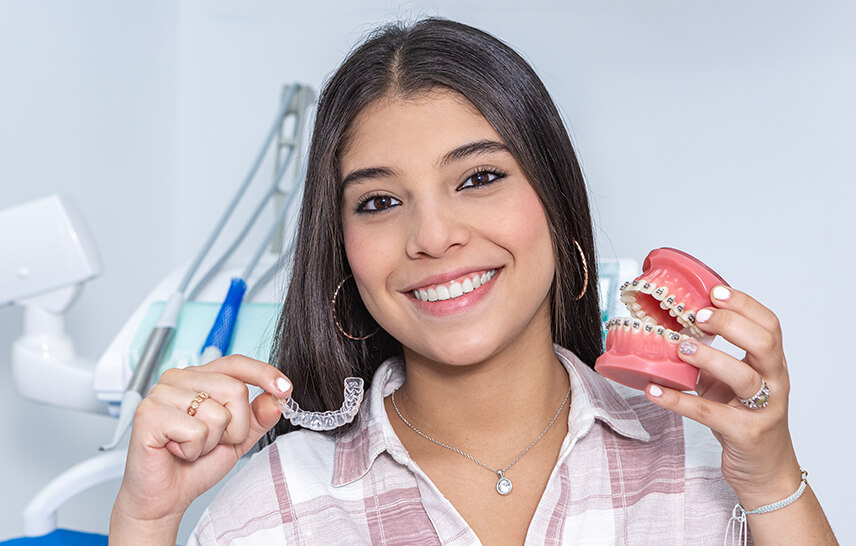
Planning a smile upgrade before summer? If you are weighing up clear aligners like Angel Aligners or Invisalign® against fixed options such as Damon braces or fully hidden lingual braces, the right choice often comes down to how you live and work.
This guide is written for adults who want the facts, not hype. We will cover day-to-day appearance, comfort, speech, hygiene, travel, complex tooth movements, auxiliaries for bite correction, and how BeClear’s hybrid workflows can blend speed, precision and discretion.
By the end, you should have a clear next step for your situation, whether you meet clients, travel frequently, play sport or music, or have a wedding or keynote coming up.
Angel Aligners and Invisalign® are near-invisible in photos and across a boardroom table. Most adults choose them because they barely show in everyday life. Small tooth-coloured attachments may be placed to grip aligners for precise movements, but these are discreet.
Available in metal or ceramic. Ceramic options blend well but are still visible at close range.
Bonded behind the teeth, so they are essentially invisible to others. They offer high control but can take longer to adjust to in the first weeks.
For big life moments, aligners are easy to remove for a toast or photos, then pop back in. If you need guaranteed all-day discretion without removing anything, lingual braces are the stealth option.
A mild lisp can occur for a day or two and usually settles quickly as your tongue adapts to the smooth trays.
Front-of-tooth placement rarely affects speech after the first couple of days.
Because they sit behind the teeth, some adults notice more speech change initially. Focused practice, wax and targeted adjustments help most people adapt within one to two weeks.
In all systems, the first days can bring tenderness as teeth start moving. Over-the-counter pain relief and a soft-food plan help you through the settling-in phase.
Smooth edges with no brackets or wires to rub cheeks. You may feel gentle pressure when changing to a new set.
Low-profile brackets are designed for comfort, but rubbing can happen. Orthodontic wax and saltwater rinses are your friends at first.
Tongue soreness is more common early on. Wax, relief adjustments and time usually solve it.
Comfort varies from person to person, yet most adults describe any soreness as mild and temporary.
Remove them to eat and drink anything other than water. Brush and floss normally. Rinse aligners and brush teeth before reinserting. There is no food restriction list to navigate, which makes dinners out and business lunches simpler.
Excellent hygiene is essential. Use interdental brushes around brackets and wires. Avoid very hard or sticky foods that can break brackets. Ceramic brackets stain less than elastic ties, but coloured foods can still mark elastics between visits.
The same dietary guidance applies, with added cleaning techniques for tongue-side surfaces. Your clinician will show you the most effective methods.
If you are meticulous with oral care, any system is manageable. If you want the simplest cleaning routine, aligners tend to come out on top.
BeClear uses Dental Monitoring for aligner patients so we can review progress from your phone. We also use virtual consultations for advice between visits.
Typically allow longer intervals between appointments, with remote check-ins helping maintain momentum.
Usually require in-person adjustments every six to eight weeks. If you travel frequently, visits can be planned around your schedule.
Similar in-person appointment cadence to fixed braces, with additional custom checks when needed.
If you fly frequently or split your time across multiple cities, aligners are often the least disruptive option.
Both aligners and braces can deliver excellent results across rotations, torque and vertical changes such as extrusion and intrusion. The difference lies in how forces are applied and how predictable those movements are for your specific bite.
Elastics, precision cuts, buttons and staged attachments can help aligners tackle bite corrections. Carriere Motion can establish a more favourable bite relationship before aligners, and in growing patients, AdvanSync can guide jaw development before or alongside other appliances. Temporary anchorage devices (TADs) may also be used in selected complex adult cases.
For certain severe rotations, significant root torque, complex space closure or situations requiring continuous control, Damon or lingual braces can be more efficient and predictable. They are always working, eliminating the wear-time variable.
When a case involves substantial tooth movement, extraction space closure with demanding anchorage requirements, or when you prefer not to manage appliance wear, a fixed option may be recommended. Lingual braces offer hidden aesthetics with fixed-level control, while Damon braces provide reliable mechanics with a simpler adaptation period.
At BeClear, we plan your treatment first, then choose the tool. Angel Aligners, Invisalign® and Spark™ are all high-quality clear aligner systems we use regularly. In day-to-day adult life, they are similar in appearance and comfort, and all can be paired with Dental Monitoring.
The bigger differentiator is the treatment plan itself and how auxiliaries are used to keep teeth moving efficiently.
Damon braces, whether metal or ceramic, remain a dependable fixed option when a case requires continuous control or when you prefer not to remove appliances to eat. Many adults combine a short fixed phase with aligners afterwards for finishing and flexibility.
Aligners or lingual braces keep attention on your words rather than your appliance. Aligners can be removed briefly for key moments.
Aligner patients often carry several sets and use remote scans for progress checks. If a tray is lost, contact us for guidance and contingency planning.
A custom mouthguard is straightforward with aligners because trays are removed during play. With fixed or lingual braces, a sports mouthguard is still possible, and we can advise on the correct fit.
Aligners are often the easiest solution. With fixed braces, lip protectors and embouchure adjustments can help. Lingual braces avoid lip irritation but may affect tongue positioning initially.
Aligners can be removed briefly for important moments and then reinserted. Fixed appliances can be planned with discreet ceramic or fully hidden lingual options if timing is important.
Treatment time depends on complexity, biology and how consistently you wear aligners or elastics. Both pathways can often finish within 10 to 18 months in many adult cases, although this varies significantly.
What matters most is a Specialist Orthodontist-led plan with realistic staging, refinements where needed and retention strategies that protect your results.
BeClear’s hybrid approach can shorten total treatment time or improve control by using the right appliance at the right stage. A short Damon or Carriere Motion phase can establish bite corrections efficiently before switching to aligners for refined finishing with fewer in-practice visits.
Angel Aligners and Spark™ are similar in discretion and comfort, both planned digitally and often paired with remote monitoring. Damon braces are a fixed system that can be preferable for certain complex movements or when continuous control is required.
For extensive rotations, significant torque demands, extraction space closure with strong anchorage requirements or when you prefer not to manage wear time, fixed braces, including lingual braces, are often recommended.
Yes. Elastics, buttons, precision cuts and appliances such as Carriere Motion can support overjet, overbite, underbite, crossbite and open-bite improvements. TADs may also be used in selected cases.
Aligners are often easiest for travel, sports requiring mouthguards and musicians. Fixed and lingual options still work very well with the right adjustments and protective equipment.
Your plan is designed by Specialist Orthodontists who combine digital simulations with hands-on expertise. That means you do not need to decide between aligners and braces without guidance. We will show you the projected outcome, map the bite changes and recommend a clear path.
If a short fixed phase will improve speed or accuracy, we will explain why and then transition to aligners for flexibility once the foundations are established.
If you are exploring aligners for adults, see how our approach fits around real life, from travel to events. If you want to learn more about braces options for adults, including Damon and ceramic pathways, our team can guide you through comfort, aesthetics and appointment scheduling.
Explore our aligner options for adults and arrange your free Specialist Orthodontist consultation to see a 3D smile simulation.
If you are considering fixed options, read about adult braces and book a visit to discuss ceramic, Damon or lingual pathways.
There is no one-size-fits-all answer. Clear aligners offer outstanding discretion, simple hygiene and travel-friendly care with remote monitoring. Damon and lingual braces provide continuous control and can be the smarter choice for certain complex tooth movements.
Many adults achieve the best balance through a hybrid plan that starts with fixed mechanics for efficiency and then transitions to aligners for refined finishing.
Ready to find what suits your lifestyle and timeline? Book a free consultation with our specialist team, see your projected result and leave with a clear, personalised treatment plan.
The first mention of Invisalign® should include the official Invisalign® logo alongside the brand name, with appropriate clear space and accessible alt text.
Dr Dima is a globally recognised Specialist Orthodontist and the #1 provider of Invisalign® treatment in Greater Manchester.
She works alongside a talented team who share her passion for putting stunning smiles on our patients' faces.
With 0% interest financing options, receive a fully bespoke treatment at an affordable price point.

I had an amazing experience with Laura and Paige at BeClear! I knew my case wasn’t the most complex, but my teeth were always something that secretly bothered me. Everything was explained well, there was never any pressure or pushy sell, you could tell straight away that they were the right fit for me! 14 weeks on and I can see such a difference; not only that, I FEEL happier! Thanks guys!
Read More Read Less
This time last year I was searching around looking at Google reviews for an Orthodontist, and luckily I found BeClear. I can’t fault the service, from start to finish the girls have been fantastic and really can’t do enough for you. The results from the Invisalign® treatment have been better than I could have imagined so I cannot recommend BeClear enough.
Read More Read Less
I received a 5 star service from BeClear Orthodontics, both Dr Duncan and Paige were very professional and really helpful throughout the process. They were also very knowledgeable in giving me all the information I needed to help me make a decision on getting Invisalign® or traditional braces.
Read More Read Less
I’m currently mid-way through my treatment plan and I can’t believe how easy everything has been so far. I’d avoided getting my teeth straightened for so long as I thought I’d need to keep going back to get my teeth assessed and adjusted, but doing everything remotely after the initial consultation & adjustment fitting was so handy and convenient!
Read More Read Less
I finished my treatment with BeClear 6 months ago, I couldn’t be more happy than I am right now with my new smile. I can say BeClear has been my best decision – Dr Duncan and her staff have been amazing. I don’t have enough words to describe how great, caring and professional they have been. If anyone wants to improve their smile, check out BeClear and you will see after the first 10 minutes, you are in the right place with the best people.
Read More Read Less
I cannot recommend BeClear Orthodontics enough! The whole team has been brilliant throughout. Dr Duncan really cares about getting you your perfect smile and makes sure you are happy with the results. She has changed my smile in a way I didn’t think was possible with Invisalign®! Thanks so much!
Read More Read Less
I cannot recommend Dr Laura and the team at BeClear enough! I’d been looking at quite a few different orthodontists over the last 2-3 years before I finally found BeClear and knew instantly it was the right fit for several reasons. The whole process from start to finish was really clear and friendly. There was none of the pressure I’d had with other orthodontists in pushing you to sign up, which spoke volumes about their overall approach in going above and beyond to make their clients feel comfortable.
Read More Read Less
I honestly cannot fault BeClear Orthodontics and their service. The team are so welcoming from the get go and so easy to contact throughout the process if you have any questions. The remote element is fantastic. I would (and have!) recommended BeClear to everyone I know. 5 stars all round – thank you BeClear team!
Read More Read Less
I went to visit Laura and the team last February believing there was nothing that could be done with my teeth. I had hated them for as long as I remember, but resigned myself to the fact that they would always look awful. I’m not a fan of dentists full stop, but when you step inside the clinic you are met with such friendly staff that you cannot help but feel at ease. Every single person I spoke with, on the phone, over WhatsApp or on the dental app, were so friendly and helpful.
Read More Read Less
I’ve always wanted to have my teeth straightened as it was something I was hugely self conscious of. Aware that it is a financial investment to be taken seriously, I was keen to find the right practice for the job. Dr Duncan and her team are those people! Hugely supportive, positive and always there to answer any question; the whole process has been wonderful and the result, a perfect set of pearly whites!
Read More Read Less
Absolutely amazing practice! Hands down the best girls and treatment for myself with my Invisalign® and for my daughter with her fixed braces. We love coming to see you! Thank you for making the daunting experience of getting braces a pretty cool and exciting thing to be going through. Legends, all of you!
Read More Read Less
I visited BeClear Orthodontics today to find out how they could help me improve my teeth with Invisalign®. The practice is new, and all the equipment and technology is the very latest and state of the art. Laura and Paige were welcoming and made me feel comfortable and at ease. Even though the practice is new, Laura is very knowledgeable and experienced. I cannot wait to start my treatment and know I will be in very capable hands!
Read More Read Less
Dr Duncan, Paige and the whole team were excellent throughout my Invisalign® experience. I can’t recommend BeClear enough! They made the whole process really easy and were always available to deal with any questions/queries I had. I’ll miss checking in with them. Thanks a lot guys!
Read More Read Less